

Yamuna’s Pink Froth: How Textile Pollution is Changing Our Rivers
For decades, the Yamuna River has carried the burden of Delhi’s growth by absorbing its sewage, its waste, its neglect. But the recent appearance of pink froth along its surface marks a shift that is difficult to ignore.
Rivers don’t change color without reason. What we are witnessing is a visible manifestation of industrial excess. Its a signal that the chemistry of our consumption has begun to rewrite the chemistry of our ecosystems.
What Is Yamuna’s Pink Froth?
Foam formation in polluted rivers is not new. It is typically the result of surfactants, phosphates, and organic waste interacting with water under turbulent conditions.
What is new and deeply concerning is the color.
However, the pink coloration indicates something more specific:
- Presence of synthetic textile dyes
- Mixing with untreated sewage and industrial chemicals
- Reaction under turbulent water conditions
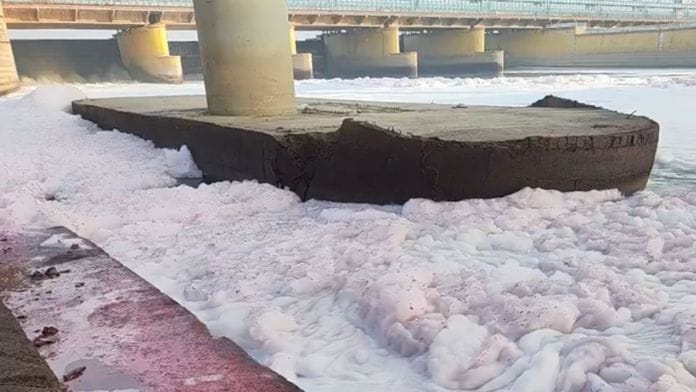
These dyes are designed to be long lasting and resistant, which makes them particularly harmful once they enter natural ecosystems.
Ecological and Public Health Implications
The implications extend far beyond surface aesthetics.
Ecological stress
- Reduced dissolved oxygen levels disrupt aquatic life
- Persistent chemicals alter microbial & plant ecosystems
- Bioaccumulation of toxins affects the broader food chain
Human exposure
- Direct contact can cause skin irritation and allergies
- Airborne toxins from foam can trigger respiratory distress
- Long term exposure raises concerns around chronic health risks
In environmental terms, such changes indicate a system under sustained stress i.e, gradually losing its capacity to regenerate.
The Scale of the Problem
The journey from textile production to river pollution follows a predictable chain
Dyeing → chemical wastewater → drains → Yamuna → turbulence → foam
To understand what’s happening to the Yamuna, we need to zoom out. The global fashion industry is one of the largest polluters in the world
- The fashion industry is responsible for 20% of global industrial wastewater
- Textile dyeing and treatment contribute significantly to this, releasing toxic chemicals into water bodies
- Over 100 billion garments are produced globally every year, many using synthetic dyes
- Less than 1% of clothing is recycled into new garments
In India, the situation is intensified by high production demand, dense industrial clusters and inconsistent wastewater treatment enforcement.
Fast Fashion: The Cost Behind Low Prices
Fast fashion operates on a simple formula of produce more, faster, and cheaper. But the environmental trade offs are significant:
- Synthetic dyeing processes are chosen for speed and cost efficiency
- Wastewater treatment is often seen as an additional expense
- The true cost is externalized onto ecosystems like the Yamuna
A single dyed garment can require tens of liters of water, much of which becomes contaminated during processing. When scaled across millions of garments, the impact becomes exponential.
What Sustainable Brands Are Doing Differently
In contrast, sustainable fashion brands are working to reduce this impact at every stage.
1. Lower impact dyeing
- Use of plant based and natural dyes
- Reduced reliance on synthetic chemicals
2. Water responsibility
- Minimizing water usage
- Ensuring wastewater is non-toxic or treated
3. Circular thinking
- Designing for longevity
- Reducing overproduction
4. Alternative techniques
- Methods like eco printing, which eliminate chemical dyes altogether
These approaches may not match the speed of fast fashion but they significantly reduce environmental harm.
Kokikar's Philosophy
Our approach is rooted in the belief that textiles should not come at the cost of ecosystems. By working with eco printing techniques, we replaces chemical dyeing with a process rooted in natural interaction where leaves, flowers, and fabric come together without synthetic intermediaries. Each piece is created with minimal environmental impact & production aligns with the principles of slow fashion
This approach ensures minimal water contamination, absence of toxic residues & a product that is inherently biodegradable in its aesthetic journey.
In a landscape where rivers are bearing the cost of industrial processes, such alternatives offer a necessary shift.
Why this matters now
The pink froth on the Yamuna is part of a broader global pattern. As fashion consumption continues to rise, so does its environmental footprint. But awareness is also growing. Consumers, policymakers, and brands are beginning to recognize that,
- Sustainability is not optional
- Transparency is essential
- Accountability must extend beyond the final product
Conclusion
The story of the Yamuna is ultimately a story about visibility. For years, the environmental cost of fashion remained hidden, diluted in wastewater, buried in supply chains. Now, it is rising to the surface.
Quite literally. The question is no longer whether change is needed but how quickly it can happen.
Choose fashion that respects natural systems.
Support brands that reduce environmental harm.
Because every garment has a journey and that journey shouldn’t end in a river.